Dishwasher Safe Sublimation Mugs: How to Verify Coating Durability Before Buying?

When a buyer emailed me last month asking why her "dishwasher-safe" mugs were fading after three months, I knew exactly what had happened. She assumed the label meant forever. It doesn't. The coating wears out faster than the ceramic breaks, and most buyers discover this only after customer complaints pile up.
"Dishwasher-safe" on sublimation mugs refers to coating durability, not ceramic strength. The coating can survive 20 dishwasher cycles and still fail after 50, generating returns. Before ordering, buyers should request pre-production cycle tests that match their customers' actual usage patterns—verification after shipment wastes money and credibility.
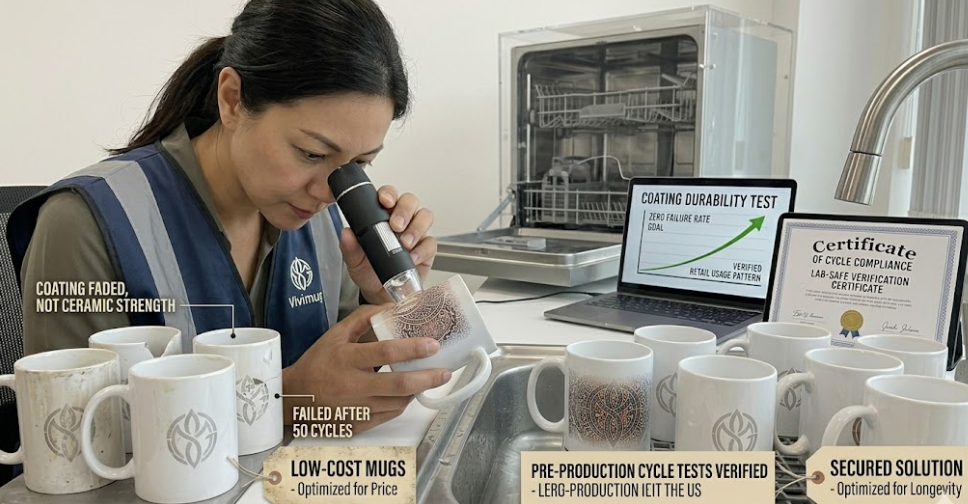
Most POD sellers and wholesalers I talk to confuse general product safety with long-term durability. Certifications tell you the coating is food-safe, not how many washes it survives. That gap costs you returns.
Are Sublimation Mugs Dishwasher Safe?
The question itself assumes a yes-or-no answer. In our factory, we see it differently. Durability is a spectrum, not a switch. Some coatings handle 30 cycles before visible fading. Others go 100+ cycles with minimal wear. The real question is: which durability level matches your business model?
Sublimation mugs can survive dishwashers, but coating lifespan varies by manufacturing process. A mug rated "dishwasher-safe" may fade after 20-30 cycles if the coating is thin or improperly baked. Buyers should clarify expected cycle count with suppliers before ordering to avoid mismatched expectations.
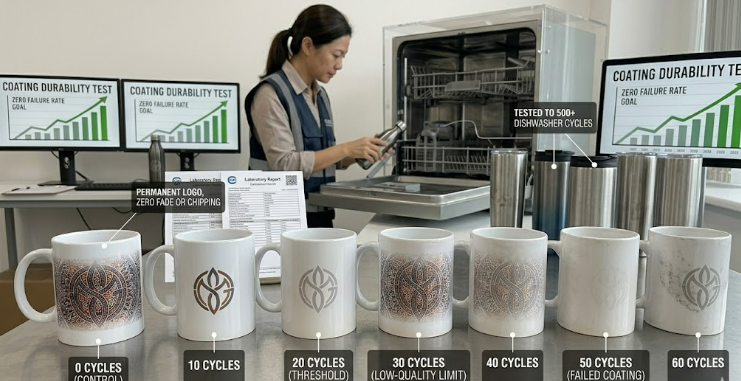
When we run 100-cycle dishwasher tests in our production line, we track three failure modes: edge wear, color fading, and surface flaking. Edge wear shows up first—usually around the rim where detergent concentration is highest. Fading follows if the coating wasn't fully polymerized during baking. Flaking happens when adhesion to the ceramic base is weak, often from contaminated surfaces before coating application.
Here's what I've learned from testing batches for different buyers:
| Coating Quality Level | Typical Cycle Count Before Visible Fade | Common Failure Mode | Best Use Case |
|---|---|---|---|
| Economy Grade | 15-30 cycles | Edge wear + fading | Single-use promotional gifts |
| Standard Grade | 40-70 cycles | Gradual fading | Retail customers with hand-wash preference |
| Premium Grade | 80-120 cycles | Edge wear only | High-use environments, repeat buyers |
The coating thickness matters more than most buyers realize. We measure it in microns—thicker isn't always better (it can crack), but too thin means faster degradation. Our standard coating is 8-12 microns. Some budget suppliers go as low as 5 microns to cut costs. The difference shows up after 20 washes.
Baking temperature and duration also determine durability. We bake at 180-200°C for 60-90 seconds. If a supplier rushes this process to increase throughput, the polymer doesn't fully cure. The coating looks fine initially but breaks down faster under heat and detergent stress.
One corporate buyer ordered 5,000 mugs for employee gifts. She wanted dishwasher-safe but didn't specify cycle expectations. We asked: "Will these sit in offices and get washed once a week, or go through commercial dishwashers daily?" She hadn't considered that. We recommended premium-grade coating for her use case. Six months later, no complaints.
How Long Do Sublimation Mugs Last?
This question frustrates me because the answer depends entirely on usage patterns. A mug hand-washed weekly can last years. The same mug run through a commercial dishwasher daily might fade in months. We can't control your customer's behavior, but we can match coating durability to likely scenarios.
Sublimation mug lifespan ranges from 6 months to 3+ years depending on washing frequency and method. Hand-washed mugs retain prints longer than dishwasher-cycled ones. Coating durability, not ceramic strength, determines lifespan—buyers should calculate acceptable degradation rates based on customer usage rather than expecting indefinite durability.

I once had a POD seller complain that mugs were fading after "only two months." We asked customers to send photos. Half showed edge wear consistent with daily dishwasher use—roughly 60 cycles. The mugs performed exactly as expected for standard-grade coating. The seller's mistake was marketing them as "lasts forever" without understanding the coating's limits.
Here's the durability breakdown I share with buyers:
Hand-wash scenario (1x/week):
- Economy grade: 2+ years before noticeable fade
- Standard grade: 3-5 years with gradual color softening
- Premium grade: 5+ years, mostly edge wear
Regular dishwasher (3x/week):
- Economy grade: 3-6 months before complaints
- Standard grade: 12-18 months before visible fade
- Premium grade: 2-3 years with acceptable wear
Commercial dishwasher (daily):
- Economy grade: 1-2 months—don't use for this
- Standard grade: 4-8 months
- Premium grade: 12-18 months
Temperature matters too. Consumer dishwashers run at 50-60°C. Commercial units hit 70-80°C. Higher heat accelerates polymer breakdown. Detergent pH also plays a role—alkaline detergents are harsher on coatings than neutral ones.
One wholesale buyer asked us to test mugs at 90°C to simulate worst-case restaurant environments. We ran 50 cycles. Premium-grade coating survived with minor edge wear. Standard-grade faded noticeably. That test convinced him to pay 12% more per unit for premium coating. His return rate dropped from 8% to under 2%.
The key is setting realistic customer expectations. If you're selling to home users who wash mugs once a week, standard-grade works fine and saves you money. If your mugs go into commercial kitchens, premium-grade is the only choice that avoids disputes.
What Are Sublimation Mugs Coated With?
I'm not a chemist, so I won't pretend to explain molecular structures. What I know from 15 years of production is this: the coating is a polymer layer that bonds to ceramic under heat. The polymer accepts sublimation ink during transfer. Its durability depends on how well it's applied and cured, not just its chemical composition.
Sublimation mugs use polymer-based coatings designed to accept ink under heat transfer. Coating durability depends on application thickness, curing temperature, and ceramic surface preparation—not just the polymer formula. Buyers should focus on verifiable production controls rather than chemical composition details when evaluating suppliers.
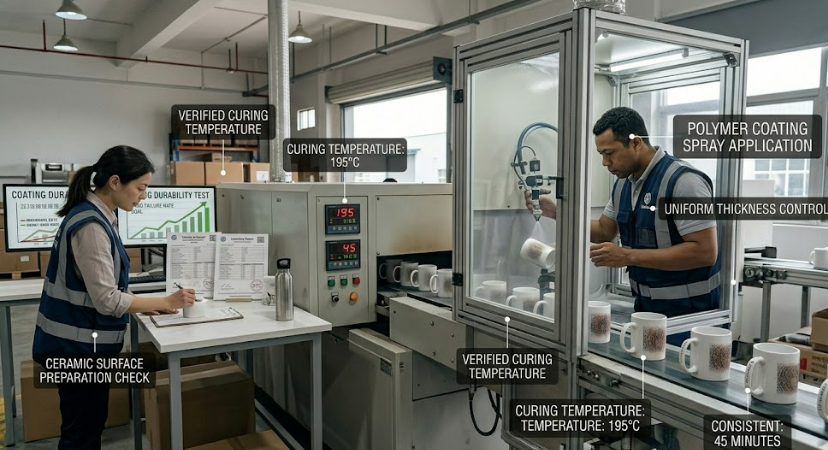
Suppliers who talk only about "high-quality polymer" without mentioning production controls are hiding something. We control four variables that matter more than the polymer brand:
-
Surface cleanliness before coating: Oils or dust prevent adhesion. We use ultrasonic cleaning + air ionization to eliminate contaminants.
-
Coating thickness uniformity: We spray-apply coating in climate-controlled rooms (humidity below 60%) and measure thickness at five points per mug. Variation over 2 microns gets rejected.
-
Baking process stability: Our tunnel oven maintains ±5°C temperature variance. Some factories use batch ovens with ±15°C swings—that inconsistency causes random failures.
-
Post-cure inspection: We test 2% of each batch in accelerated dishwasher cycles (80°C, 20 cycles) before shipping. If failure rate exceeds 5%, we rebake the entire batch.
I've seen buyers accept lower prices from suppliers who can't explain their coating process. Three months later, they're dealing with fading complaints. The coating chemistry was probably fine—the application process wasn't.
FDA and LFGB certifications confirm the coating is food-safe. They don't test dishwasher durability. A mug can be certified and still fade quickly. Buyers who assume certification equals durability are misunderstanding what those documents cover.
When evaluating suppliers, ask these questions:
- What's your coating thickness range?
- How do you verify thickness consistency?
- What's your baking temperature and duration?
- Can you provide dishwasher cycle test results?
- What's your batch rejection rate for coating defects?
If they can't answer with specifics, move on. You'll pay for that ignorance later through returns.
Conclusion
Dishwasher-safe isn't a promise—it's a durability estimate that depends on coating quality and customer usage. Verify before ordering, not after complaints. Request cycle tests that match your market, and price your products with realistic degradation timelines. That's how you avoid return headaches.

Hi there! I'm Lucy, the guardian angel of two good children. During the day, I am a professional in the heat transfer printing industry, from factory workshops to running my own business. Here I share what I have learned - let's grow together!