How to Sublimate on Ceramic Mugs?
Tired of faded mug designs that peel and wash away? You want professional, vibrant results, but inconsistencies ruin your blanks. Getting the process right is crucial for a successful product.
Yes, sublimating ceramic mugs is a fantastic, popular method. The key is to use mugs with a special polymer coating, apply consistent heat and pressure with a mug press, and use high-quality sublimation ink and paper for permanent, photo-quality results.
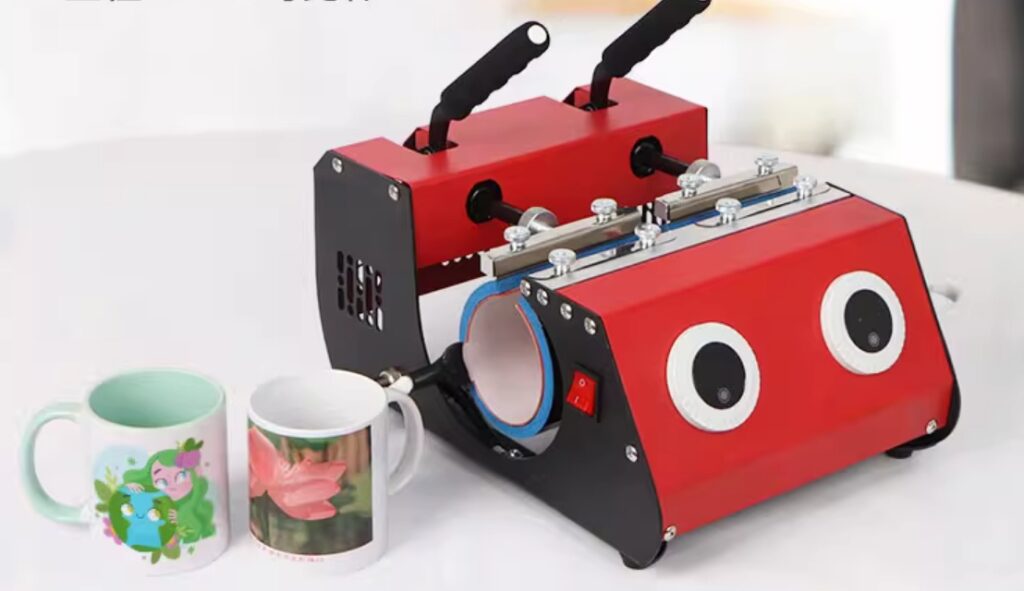
When I started working in a sublimation factory years ago, mugs were our bread and butter. They are the perfect product: practical, personal, and always in demand. I must have pressed thousands of them. Today, they are still a top seller for the clients I help. While the process seems simple, a few critical details separate a perfect, sellable mug from a coaster. Let's break down the most common questions to ensure every mug you create is something you can be proud of.
Can you use sublimation on ceramic mugs?
You see beautiful custom mugs everywhere. You want to create them too, but you're not sure if the process is reliable. Don't let uncertainty stop you from making profitable products.
Absolutely. Sublimation is the best method for creating permanent, full-color designs on ceramic mugs. The critical requirement is that you must use mugs specifically sold as "sublimation blanks."
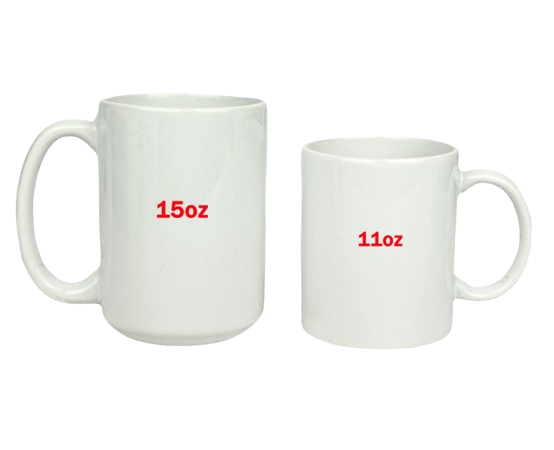
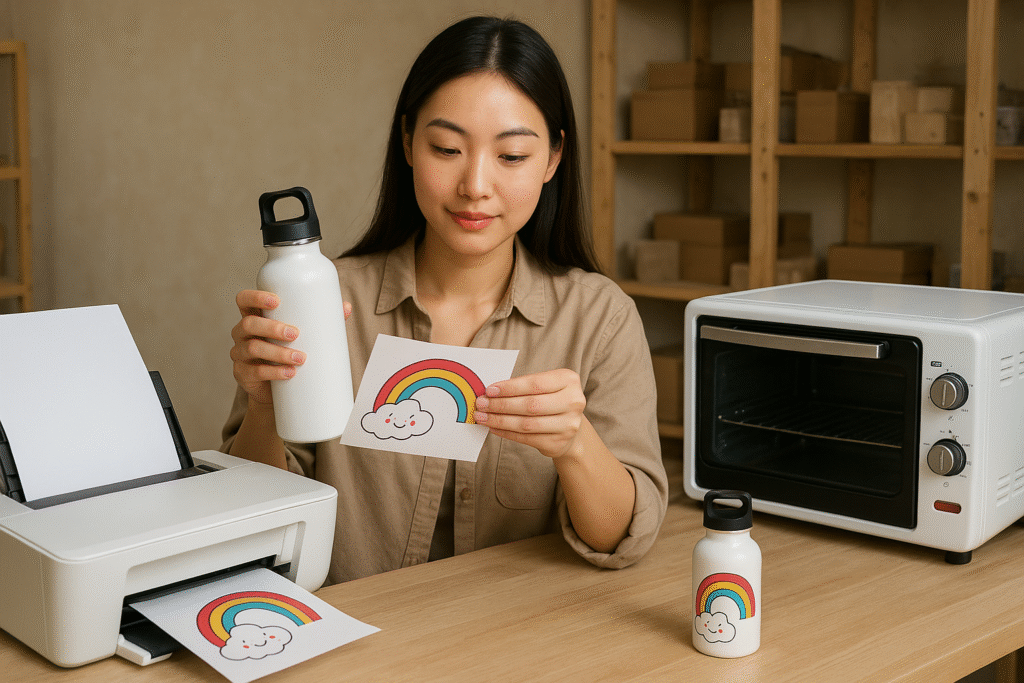
The magic of sublimation on mugs lies in a special coating. This clear, polymer layer is applied at the factory and is completely invisible. When you heat the mug with your sublimation transfer, the ink turns into a gas. This gas then infuses into the polymer coating. As it cools, the ink solidifies, becoming a permanent part of the mug's surface. My product specialist, Alex, explains that this process creates a design that is both dishwasher and microwave safe. Unlike vinyl stickers that can peel or screen printing that can crack, a sublimated design will not fade, scratch, or wash away. It’s a truly professional and durable finish. This is why sublimation mugs are so popular for personalized gifts, corporate branding, and novelty items.
| Feature | Sublimation Mug | Regular Mug with Vinyl |
|---|---|---|
| Durability | Permanent, won't peel or fade | Can peel, crack, or lift over time |
| Dishwasher Safe | Yes, top rack recommended | No, handwash only recommended |
| Feel | Perfectly smooth surface an | Raised or textured feel |
| Design Complexity | Full-color photos, gradients | Best for solid colors, simpler shapes |
Can you sublimate directly onto ceramic?
Thinking of saving a few bucks with cheap ceramic mugs from a craft store? This common mistake leads to wasted time, faded designs, and lots of frustration. Know your materials first.
No, you cannot sublimate directly onto untreated ceramic. The surface of a standard ceramic mug is porous and lacks the necessary polymer coating for the sublimation ink to bond with.

I learned this lesson the hard way. Early in my journey, I bought a case of beautiful, cheap mugs from a restaurant supplier, thinking I’d found a goldmine. I spent a whole afternoon printing transfers and pressing them. Coming out of the press, they looked okay, but the second I touched them, the designs smudged and wiped right off. All I had was a faint, blurry stain and a pile of wasted mugs. That's because regular ceramic has a glaze, but not the right kind of coating. Sublimation ink needs polymer molecules to connect with. Without that special coating, the ink gas has nowhere to go. It just cools and sits on the surface like colored dust. You absolutely must buy mugs that are specifically advertised as "sublimation blanks." They are designed for this process and will give you the vibrant, permanent results you want.
How long do you press ceramic mugs for sublimation?
Are your mugs coming out blurry, faded, or with brown scorch marks? Incorrect time and temperature are the usual culprits. Stop guessing and start pressing with precision for perfect results.
Most ceramic mugs press for 180-240 seconds at 190-200°C (375-400°F). However, you must start with the manufacturer's recommendation for your specific mugs, paper, and heat press, then test.
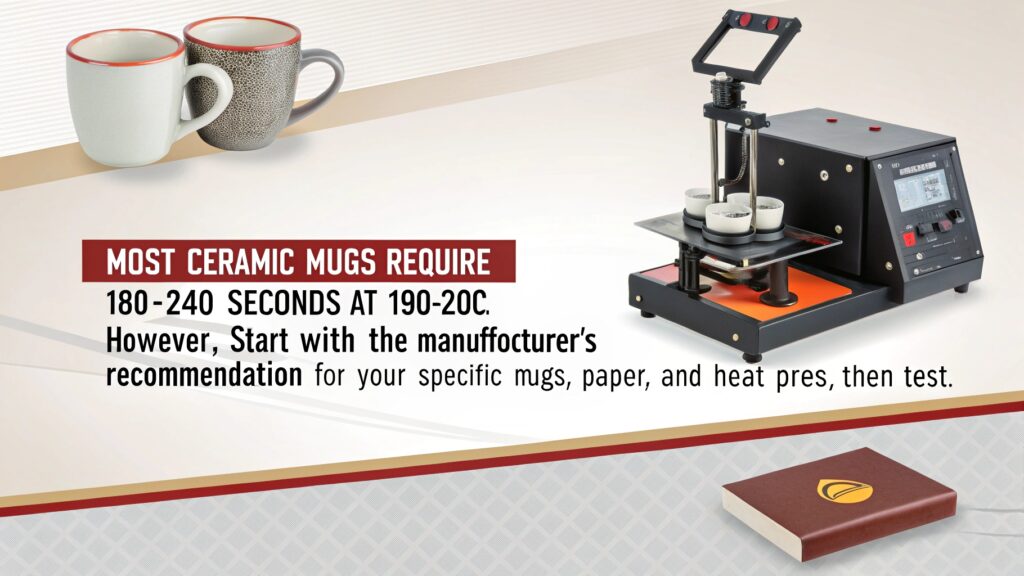
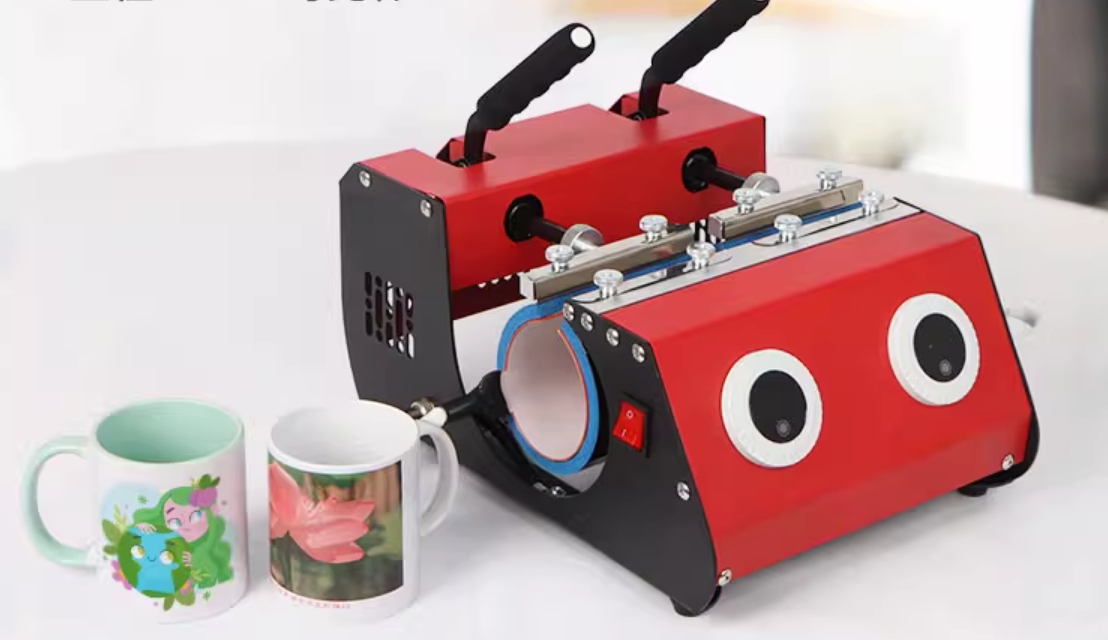
Think of sublimation as a recipe with three key ingredients: time, temperature, and pressure. All three have to be right. Alex calls this the "sublimation trifecta." Every combination of mug press, ink, paper, and blank mug is slightly different. That's why I always tell my clients to test one mug before starting a big order. Keep a logbook of your settings! If your designs look faded, you probably need more time or a slightly higher temperature. If the edges are blurry or the paper is turning dark brown, you are over-pressing—reduce the time or temperature. Uneven pressure can also cause light or blurry spots. Make sure your mug is snug in the press from top to bottom. Finding your perfect settings might take a few tries, but once you find that sweet spot, you can produce perfect mugs consistently.
| Problem | Likely Cause | Solution |
|---|---|---|
| Faded, Washed-Out Colors | Under-cooked | Increase time by 15 seconds or temp by 5°C. |
| Blurry or Bleeding Edges | Over-cooked | Decrease time by 15 seconds or temp by 5°C. |
| "Ghosting" or Double Image | Paper shifted | Use heat tape securely; don't move mug while hot. |
| Uneven or Splotchy Print | Uneven pressure/heat | Adjust pressure; check your press heating element. |
Can you turn a regular mug into a sublimation mug?
You have a stock of plain mugs and want to turn them into sublimation blanks. It seems like a smart way to save money, but don't invest in coatings until you know the facts.
Technically, yes, you can apply a special sublimation coating spray or liquid to a regular mug. However, achieving a smooth, even, and durable finish at home is extremely difficult and rarely cost-effective.
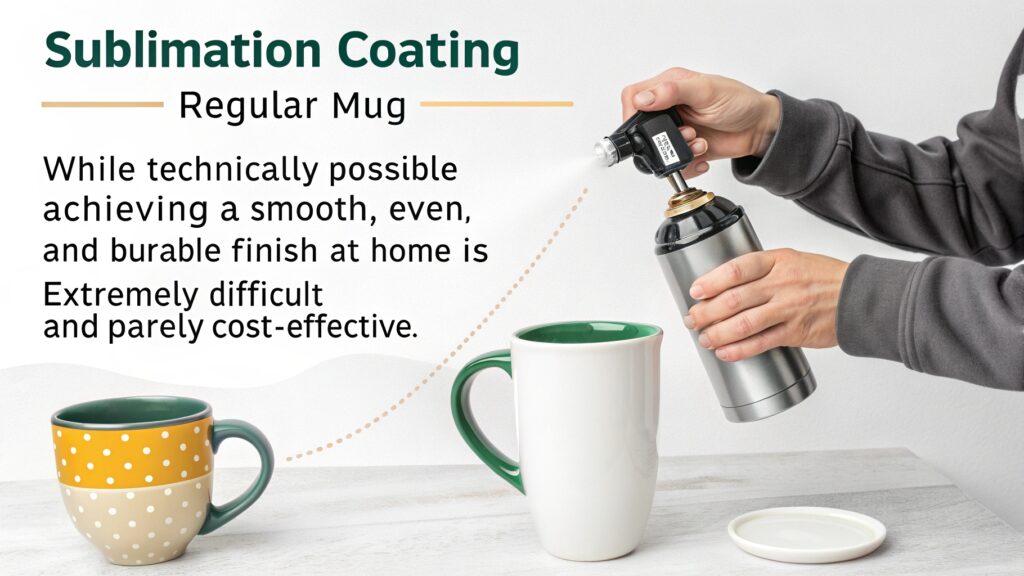
I've had clients ask me this when they see the DIY coating sprays online. I always advise against it for anyone running a business. The process is very unforgiving. You have to apply the coating in a dust-free environment, ensure it goes on perfectly smooth with no drips, and then cure it at a specific temperature. The results are often disappointing. You can get streaks, bubbles, or a yellowish tint that ruins the vibrant white base. Alex also points out that these DIY coatings often lack the durability and food-safe qualities of factory-coated mugs. When you factor in the cost of the spray, the time spent, and the number of mugs you will ruin trying to get it right, it's far cheaper and more reliable to simply buy high-quality, pre-coated sublimation blanks. For a professional, consistent product that your customers can trust, stick with mugs made for the job.
Conclusion
For perfect mugs, always use polymer-coated blanks. Master your press settings for time and temperature. Quality blanks are the foundation for professional, permanent designs that your customers will love.

Hi there! I'm Lucy, the guardian angel of two good children. During the day, I am a professional in the heat transfer printing industry, from factory workshops to running my own business. Here I share what I have learned - let's grow together!