Is Sublimation Printing the Same as Heat Transfer?

You hear the terms "sublimation" and "heat transfer" used interchangeably. The confusion makes it hard to buy the right supplies. You risk wasting money on a process that won't work for your project.
No, they are not the same. Sublimation is a specific kind of heat transfer where dye turns to gas and chemically bonds with the material. General heat transfers, like vinyl, use adhesive to stick a layer on top of the material.
This is probably the biggest question people have when they start out, and I get it completely. When I was building my company, helping clients understand this difference was key to their success. Think of it this way: all squares are rectangles, but not all rectangles are squares. In the same way, all sublimation is a form of heat transfer, but not all heat transfer is sublimation. Let's look closer at what that means.
Is sublimation a form of heat transfer?
The language can be very confusing. You hear about the "heat transfer" process and wonder if sublimation is just another name for it. It is hard to know how to categorize them.
Yes, sublimation is a specialized form of heat transfer. The term "heat transfer" is a broad category of methods that use heat to apply a design. Sublimation is one specific, advanced technique within that family.

My technical specialist, Alex, loves to clarify this for our clients. He explains that "heat transfer" is the parent category for any decoration method that uses a heat press. Sublimation falls under this umbrella, but so do several other popular methods.
this umbrella, but so do several other popular methods.
The Heat Transfer Family
- Sublimation: Uses heat to turn solid dye into a gas. This gas then permeates and permanently bonds with polyester fibers or a polymer coating. The result is a print you cannot feel.
- Heat Transfer Vinyl (HTV): This involves cutting a design from a sheet of colored vinyl. The vinyl has a heat-activated adhesive on the back. When pressed, it sticks to the surface of the fabric, creating a tangible layer.
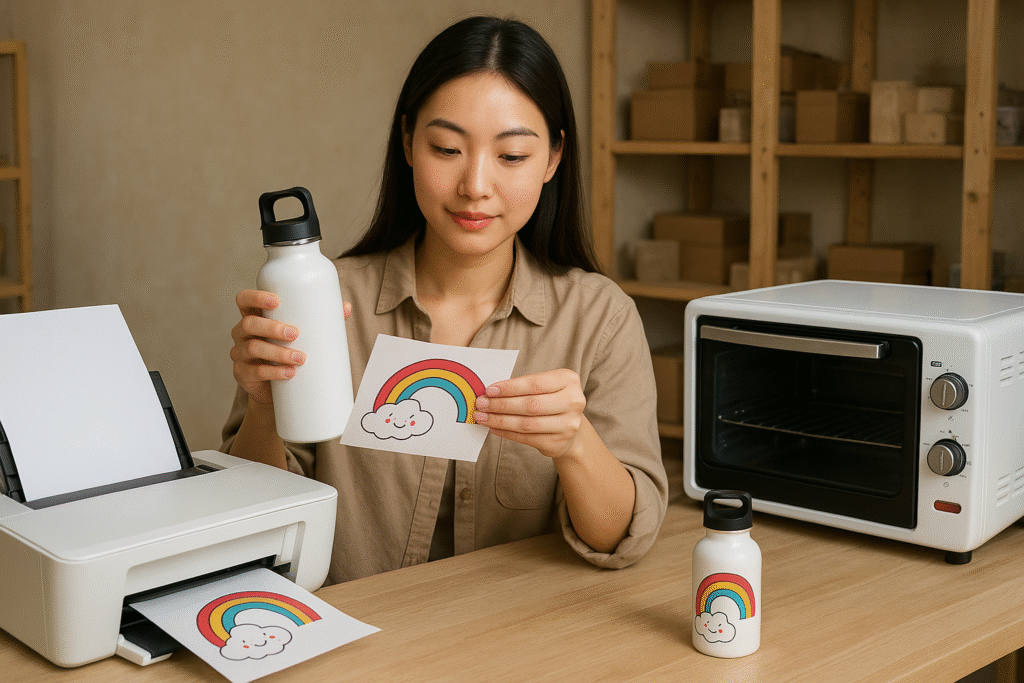
- Printable Transfer Paper: This uses a standard inkjet printer to print a design onto special paper with an adhesive film. This film is then heat-pressed onto the shirt, similar to a high-tech sticker.
| Method | How It Works | Feels On Fabric |
|---|---|---|
| Sublimation | Dye turns to gas and bonds with fibers. | Zero feel, perfectly smooth. |
| Heat Transfer Vinyl | Adhesive layer melts onto the surface. | Tangible, plastic-like layer. |
| Printable Transfer Paper | Adhesive film bonds to the surface. | A thin, stiff layer. |
Which is better, heat transfer or sublimation?
You want to produce the best quality products you can. But with so many options, you're not sure which is best. You're afraid of choosing a method that fades, cracks, or feels cheap.
Neither is better overall; they are for different jobs. Sublimation is better for photo-quality durability on light polyester. Other heat transfers like vinyl (HTV) are better for cotton, dark fabrics, and special effects like glitter.
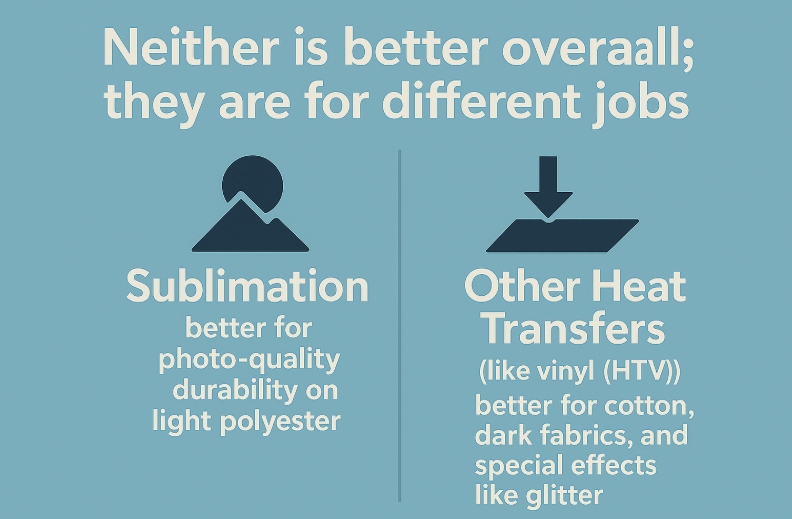
I help clients make this decision every day. The answer always comes down to two questions: What are you printing on, and what does your design look like? The "best" method is the one that fits your specific project.
When to Choose Sublimation
Choose sublimation when your priorities are durability and vibrant, full-color images. It's the undisputed champion for polyester athletic apparel because the print is breathable and will never crack or peel. It is also perfect for producing photo-quality images on hard-surface items like mugs, tumblers, and keychains that have a special polymer coating.
When to Choose Other Heat Transfers
Choose Heat Transfer Vinyl (HTV) when you want to print on 100% cotton or dark-colored fabrics. Since HTV is an opaque layer that sits on top, it looks great on any color material. It's also the go-to for simple text or logos, or when you want special finishes like glitter, metallic foil, or flock (fuzzy) textures. Printable transfer paper is a good entry-level option for cotton but is less durable than HTV or sublimation.
Can a Cricut do sublimation printing?
You have a Cricut machine at home and see them marketing "Infusible Ink." You're wondering if this means your Cricut can actually print sublimation designs, saving you from buying a new printer.
No, a Cricut machine cannot print. It is a cutter. You cannot print sublimation designs with it. However, a Cricut can cut pre-printed sublimation paper, or it can cut Cricut's own brand of solid sublimation sheets, called Infusible Ink.
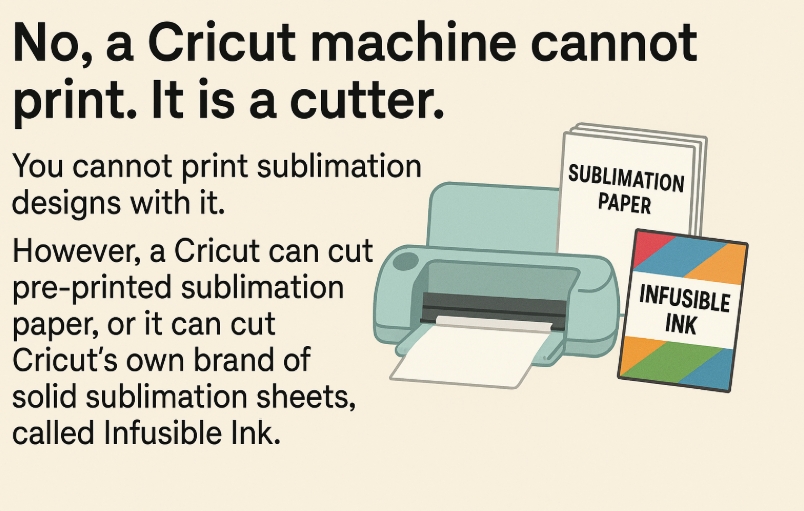
This is a really important distinction. Your Cricut is an amazing tool in the sublimation workflow, but it is not a printer. Think of it as a pair of super-precise scissors. You still need an artist—in this case, a sublimation printer—to create the image first.
The Role of Each Machine
- Sublimation Printer: This is a dedicated inkjet printer (like a converted Epson EcoTank) filled with sublimation ink. Its only job is to print your custom photos and full-color designs onto sublimation paper.
- Cricut Machine (Cutter): Its job is to cut shapes. You have two ways to use it for sublimation. First, you can cut shapes from solid-color sheets of Cricut's Infusible Ink. This is great for simple text or graphics. Second, you can print a design from your sublimation printer and then use your Cricut's "Print Then Cut" feature to perfectly cut around the printed design. This gives you a precisely shaped transfer without any white edges, perfect for things like keychains or oddly shaped coasters.
What are the disadvantages of sublimation printing?
The results of sublimation look perfect and permanent. You know there must be a catch. You need to understand the limitations before you invest your time and money into the equipment.
The primary disadvantages of sublimation are its strict material requirement (polyester only), its inability to work on dark-colored items, and a susceptibility to color fading under constant, direct sunlight.
Being honest about these disadvantages is essential. I built my business on knowing what sublimation can't do just as well as what it can do. These are not small details; they are fundamental rules of the science behind the process.
The Core Limitations
- The Polyester Rule: The sublimation chemical reaction only works with polymers. This means you need 100% polyester fabric for vibrant results. On cotton or other natural fibers, the ink will not bond and will wash right out. This is the biggest hurdle for people who want to decorate standard cotton t-shirts.
- The Light Color Rule: Sublimation ink is translucent, not opaque. It dyes the fibers but doesn't cover them. Because there is no white ink, the background color of the fabric will show through your design. This is why sublimation must be done on white or very light pastel-colored substrates.
- The UV Challenge: A sublimated print is completely wash-proof, but it is not completely sun-proof. Standard dyes will fade if left in direct sunlight for months, making them less ideal for permanent outdoor applications like flags or yard signs without a special UV-protective coating.
Conclusion
Sublimation is a special type of heat transfer. Its unique process of infusing dye into polyester makes it different and better for certain jobs, while other transfers excel on different materials.

Hi there! I'm Lucy, the guardian angel of two good children. During the day, I am a professional in the heat transfer printing industry, from factory workshops to running my own business. Here I share what I have learned - let's grow together!