The Real Cost of Cheap Wholesale Sublimation Blanks: Hidden Profit Erasers
I learned this the hard way when a Dutch retailer called me last year, furious about a container of mugs. The unit price was 30% lower than our standard products. But after returns and remakes, they lost money on the entire order.
Cheap sublimation blanks don't actually save money—they just move costs from the invoice to places you don't measure until it's too late. The real question isn't which supplier charges less per piece, but which cost structure protects your margin when things go wrong.
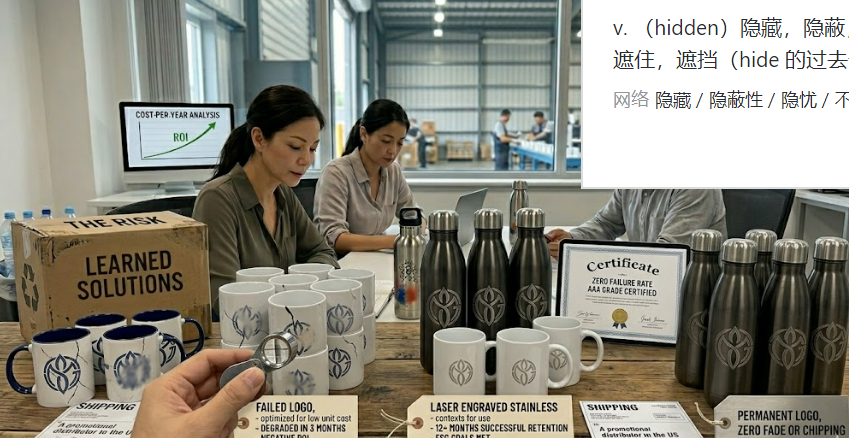
Most buyers compare unit prices in a spreadsheet. That makes sense—until your return rate climbs and you realize the "savings" evaporated.
Where is the best place to buy sublimation blanks?
I get this question every week from new e-commerce sellers. They want a supplier name, a website link, something simple.
The best place depends on your defect tolerance and order volume. A supplier perfect for bulk gift customizers might destroy margins for small Etsy sellers—because the cost structures reward different risk profiles.
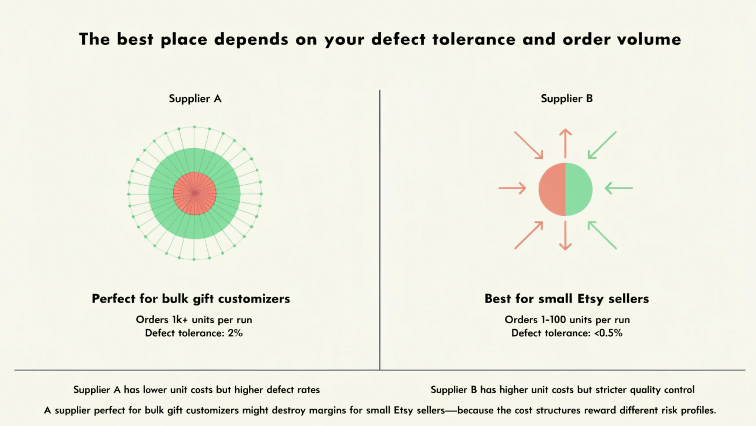
Here's what actually matters. A $2 mug with a 15% failure rate costs you more than a $3.50 mug with a 2% failure rate once you add labor, return shipping, and the customer you lose forever. I've seen this pattern dozens of times in our sales records.
The coating process creates predictable failure modes.1 When we skip the alkaline pre-treatment step (it adds about $0.40 per unit), the coating looks fine initially. But it fails after 10-15 dishwasher cycles. Small sellers notice this as scattered complaints. Bulk customizers face catastrophic remake costs when a corporate client rejects 5,000 pieces.
Different buyers face different risks:
| Buyer Type | Primary Risk | Cost Structure That Works |
|---|---|---|
| Small e-commerce (under 500 units/month) | Thin margins destroyed by returns | Medium-price blanks with proven coating durability |
| Bulk gift customizers | Large order remakes | Premium blanks with batch consistency guarantees |
| Retail chains with own testing | Price pressure from buyers | Low-cost blanks IF you can absorb QC screening costs |
The "cheap blank" illusion happens because buyers compare visible costs (unit price) but ignore invisible costs (the 3 hours you spend reprinting failed orders, the customers who never come back). I'm not saying expensive automatically means better. I'm saying the decision point isn't price—it's which failure modes you can afford.
Common buyer misunderstanding: "All coatings are basically similar, printer quality matters most." This stems from confusing surface specs (coating thickness measurements) with real-world constraints (how many wash cycles before fading, temperature tolerance variation). A coating can measure correctly but use inconsistent polymer formulas that create random failures.
When I talk to experienced wholesalers versus new sellers, the questions differ completely. New sellers ask "What's your lowest price?" Experienced buyers ask "What's your defect rate by batch?" and "How do you handle pre-treatment consistency?"
What sells the most with sublimation?
Mugs. Overwhelmingly mugs. But the answer matters less than understanding why this creates specific cost pressures.
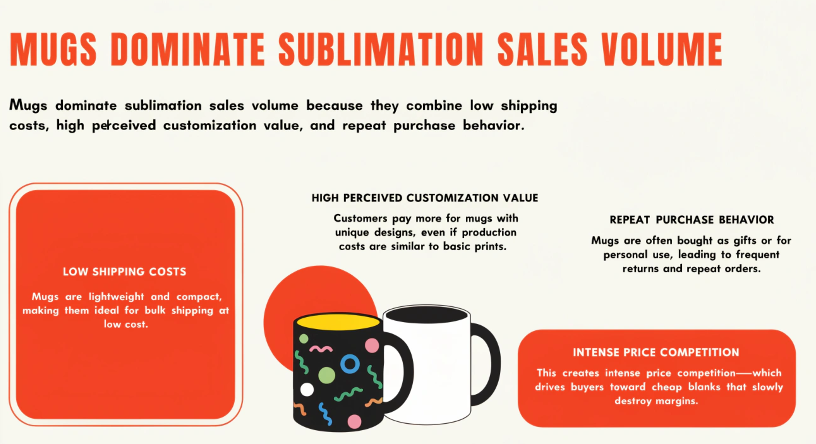
Mugs dominate sublimation sales volume because they combine low shipping costs, high perceived customization value, and repeat purchase behavior. This creates intense price competition—which drives buyers toward cheap blanks that slowly destroy margins.
From our production data, ceramic mugs account for about 60% of sublimation blank volume in home goods categories. Tumblers and water bottles follow at maybe 25%. The rest splits across specialty items.
This concentration creates a trap. When everyone sells mugs, price becomes the main differentiator—unless you protect quality enough to reduce returns below a threshold where word-of-mouth works in your favor.
The sales volume pattern affects your sourcing decision:
| Product Category | Volume Behavior | Quality Sensitivity |
|---|---|---|
| Standard 11oz mugs | High volume, repeat orders | Medium—customers tolerate some variation |
| Premium tumblers | Lower volume, higher margin | High—one failure kills repeat purchases |
| Seasonal items (ornaments, etc.) | Unpredictable spikes | Very high—no time for remakes during peak season |
I've watched sellers chase volume by lowering prices, then struggle when return rates climb. The math doesn't work—you can't compete on price alone when the product quality doesn't support the volume needed to profit from thin margins.
What actually sells depends on your positioning. If you're competing on Etsy with 10,000 other mug sellers, you need either the lowest price (which requires enormous volume to survive the defect rate) or a quality level that generates enough positive reviews to escape pure price competition.
What is the most durable sublimation blank product?
Stainless steel tumblers. But "most durable" doesn't mean "best business choice"—it means different trade-offs.
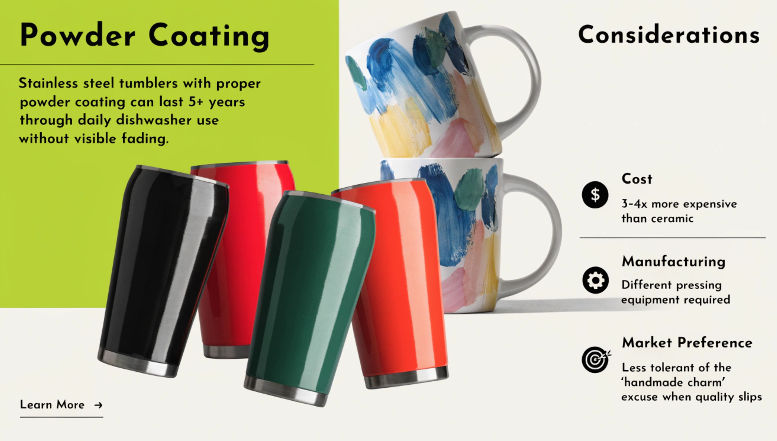
Stainless steel tumblers with proper powder coating last 5+ years through daily dishwasher use without visible fading. But they cost 3-4x more than ceramic mugs, require different pressing equipment, and serve markets less tolerant of the "handmade charm" excuse when quality slips.
The durability question actually contains two different questions: physical durability (will it break?) and coating durability (will the image last?). These don't always align.
Ceramic mugs with quality coating can maintain image vibrancy for years—but they chip when dropped. Stainless steel survives drops but cheaper coating formulas fade faster than premium ceramic coatings. Glass items look premium but break easily in shipping.
Here's how durability intersects with business costs:
| Material | Physical Durability | Coating Longevity | Hidden Cost |
|---|---|---|---|
| Ceramic (quality coating) | Low (chips easily) | High (5+ years) | Shipping breakage, not coating failure |
| Stainless steel (powder coat) | Very high | Medium to high (depends on coating) | Higher unit cost, pressing equipment needs |
| Glass (polymer coating) | Low | Medium | Shipping costs skyrocket, special packaging required |
| Plastic (limited sublimation types) | High | Low to medium | Coating adhesion problems, customer perception issues |
The factory perspective on durability: legitimate quality control in coating adds 20-30% to production cost but reduces post-delivery failures by 80%+. We see cheap suppliers skip steps like surface activation or use inconsistent coating thickness to save $0.30 per unit. The coating looks identical initially—the difference appears after 20 wash cycles or 6 months of UV exposure.
The coating failure modes we see most in customer complaints: premature fading (inconsistent polymer formula), adhesion failure creating patches (skipped pre-treatment), color shift over time (low-grade polymer exposed to heat cycles). These rarely appear in initial quality checks. They emerge during real-world use.
I can't tell you which product to sell—that depends on your market positioning, equipment investment, and risk tolerance. But I can tell you that "most durable" and "most profitable" occupy different positions on the cost-quality spectrum. Your job is matching that position to your actual business constraints, not chasing an abstract quality ideal.
Conclusion
The real decision isn't cheap versus expensive blanks—it's which cost structure matches your volume, defect tolerance, and market position. Unit price is just one variable in a bigger equation.
-
"Degradation Behavior of Polymers Used as Coating Materials for ...", https://pmc.ncbi.nlm.nih.gov/articles/PMC8070827/. Polymer coating failures follow predictable patterns related to surface preparation and curing processes, as documented in materials science research on adhesion mechanisms and degradation pathways. Evidence role: mechanism; source type: research. Supports: that polymer coatings exhibit predictable failure patterns based on processing steps. Scope note: General polymer coating research may not specifically address sublimation blank manufacturing processes ↩

Hi there! I'm Lucy, the guardian angel of two good children. During the day, I am a professional in the heat transfer printing industry, from factory workshops to running my own business. Here I share what I have learned - let's grow together!