Why Are My Sublimation Prints Failing and Wasting My Money?

You get blurry prints, faded colors, and scorched blanks. Each failed product is more money down the drain, not to mention the damage to your customer's trust and your own confidence.
This constant waste is beyond frustrating. It feels like you're working twice as hard for half the results, and you start to wonder if you can ever make your business profitable.
Your sublimation prints often fail due to low-quality blanks with inconsistent polymer coatings. Common problems like ghosting, color fading, and warping are usually symptoms of poor materials. Choosing high-quality, factory-direct blanks is the most effective way to ensure professional results.
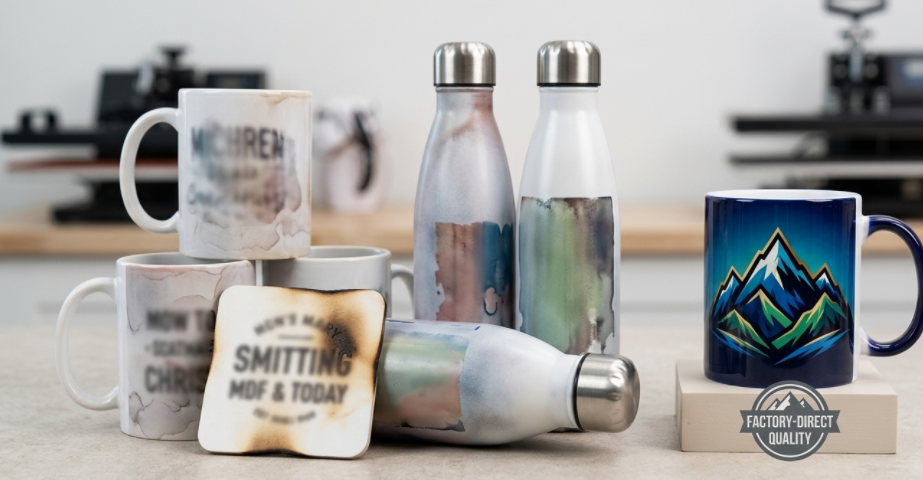
To be honest, after 11 years in the sublimation industry, I’ve seen too many beginners throw money away on low-quality blanks just to save a few cents. The result? They ruin the ink, the paper, and more importantly, they lose their customers' trust. Sublimation isn't magic—it’s all about the 'coating.' A premium coating locks in the color just like a professional non-stick pan handles heat. If you’re struggling with settings but still getting poor results, don’t blame your technique just yet. It’s highly likely your blank was 'born' with a bad coating. When you choose factory-direct blanks with consistent quality, half of your business success is already in the bag. Let's break down the most common blank-related failures and how to fix them.
Ghosting and Blurring: Why Do My Ceramic Mug Prints Look Double?
You tape your mug perfectly and press it with care. But when you peel off the paper, there's a frustrating blurry shadow or double image next to your crisp design.
This error turns a potentially beautiful product into garbage. You're forced to throw away another expensive blank, killing your profits and making you dread every press.
Ghosting on ceramic mugs is caused by either the paper physically shifting or an inconsistent polymer coating on the mug. A cheap, uneven coating can allow the ink gas to bleed sideways under heat, creating a blurry effect even if your technique is perfect.
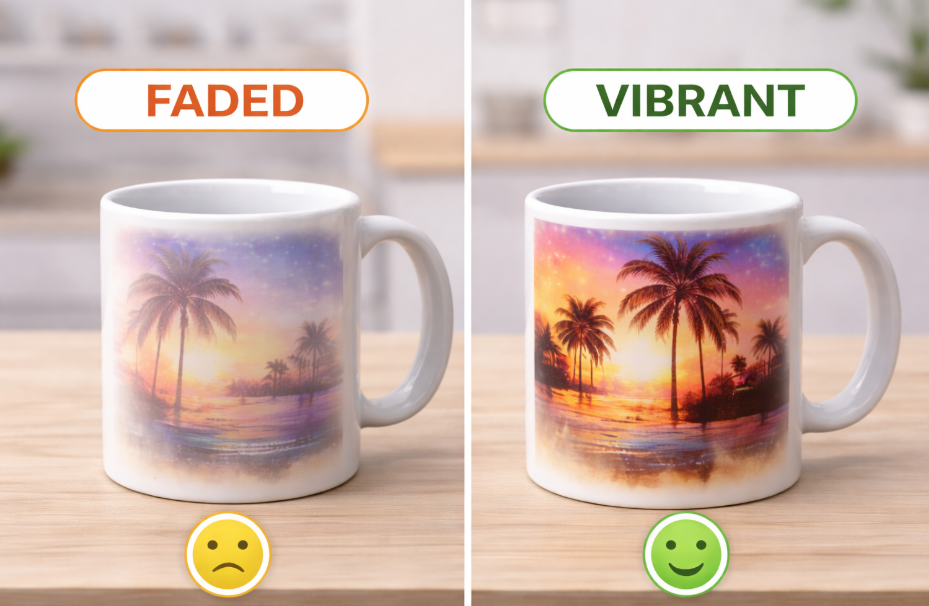
Dive Deeper: The Two Causes of Blurry Mugs
When I started my tumbler business, I thought ghosting was always my fault. I spent weeks perfecting my taping method. While technique is important, I soon learned that even with a perfectly taped mug, a bad blank will still betray you. It's crucial for a professional like Emma to understand both causes to diagnose the problem accurately.
1. The Mechanical Shift
This is the most obvious cause. If the paper slides just a millimeter while it's still hot, the ink gas will re-deposit and create a shadow. This often happens when you open a clamshell press and the vacuum lifts the paper, or when you remove the mug from the press. Securing the paper tightly with quality heat tape is the answer.
2. The Coating Failure
This is the hidden cause. A high-quality mug has a thick, hard, and uniform polymer coating. A cheap mug has a thin, soft, or uneven one. Under heat, a poor coating can let the ink gas spread out or "bleed" under the surface before it sets. The result isn't a sharp double image like a paper shift; it's more of a general fuzziness around the edges of your design.
| Symptom | Likely Cause | Solution |
|---|---|---|
| Sharp double image | Mechanical Shift | Use more heat tape; be gentle when opening the press. |
| Soft, blurry edges | Coating Failure | Switch to a premium, reputable mug supplier. |
| Both issues appear | Combination | Improve taping technique AND upgrade to better blanks. |
Color Fading on Stainless Steel: Is Your Coating Quality Up to Standard?
Your stainless steel tumblers look incredible right out of the press. But after a few runs through the dishwasher, your customer sends you a photo of a faded, blotchy mess.
This is a business nightmare. It leads to angry customers, bad reviews, and costly refunds or replacements. Your brand's reputation for quality is destroyed in an instant.
Fading on stainless steel is not an ink problem; it's a coating problem. It is caused by a low-quality polymer coating on the tumbler that is not durable enough to withstand heat, detergents, and abrasion. The coating breaks down and takes the ink with it.
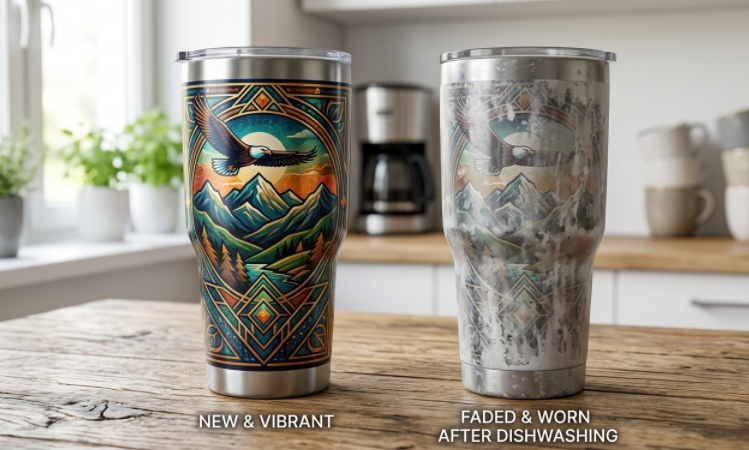
Dive Deeper: Durability is in the Blank's DNA
I almost lost a huge corporate order early in my career because of this. I tried to save a little by using a new, cheaper tumbler supplier. The samples looked great, but the final products started fading within a month. I learned that day that the price of a blank reflects the quality of its coating. You are not just selling a design; you are selling permanence.
1. What Makes a Coating "Dishwasher-Safe"?
A truly durable coating is thick, hard, and chemically stable. Reputable manufacturers invest in advanced coating technology and perform rigorous testing. They can often provide data, such as "certified for 3,000 wash cycles," which proves the coating's ability to resist the high heat and harsh detergents of a dishwasher. Cheaper blanks have a thin spray-on coating that can peel or degrade quickly.
2. How to Spot a Low-Quality Tumbler
Before you even press it, you can often spot signs of a cheap blank.
- Visual Inspection: Look for small bumps, drips, or dull spots in the coating. A premium blank will have a perfectly smooth, flawless, high-gloss finish.
- Consistency: Take two tumblers from the same case. Do they feel and look identical? Low-cost manufacturers often have poor quality control, leading to variations from one blank to the next.
- Supplier Reputation: Source your blanks from suppliers who specialize in sublimation and stand behind their products' quality and durability ratings.
Warping and Scorching: How Do I Master the Heat Press for MDF Products?
You press a beautiful design onto an MDF keychain or photo panel, but it comes out of the heat press bent and warped, with ugly brown scorch marks around the edges.
A warped or scorched product is unsellable. You've wasted the blank, your expensive ink and paper, and the time it took to create it, all for a disappointing result.
Warping in MDF (Medium-Density Fiberboard) happens when moisture trapped inside the wood turns to steam and escapes unevenly. Scorching is caused by excessive heat. Both problems are common with cheap MDF blanks that aren't properly prepared for sublimation's high temperatures.
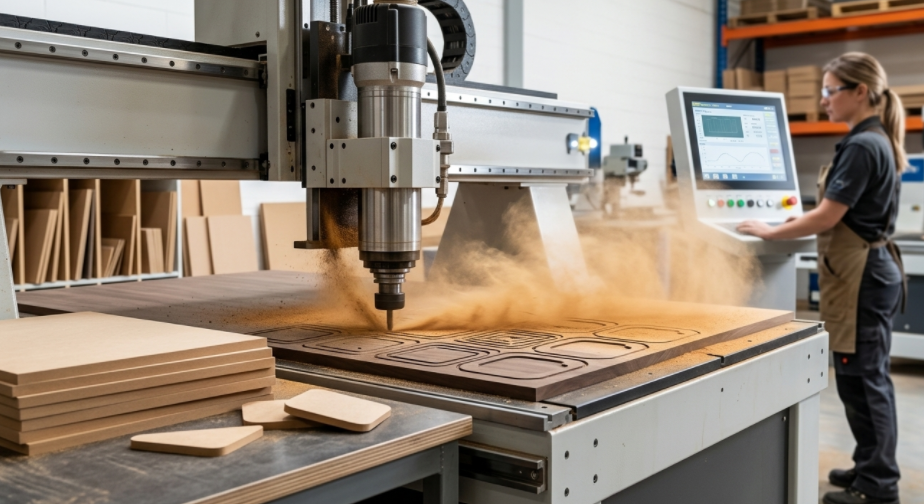
Dive Deeper: Handling Wood-Based Blanks
MDF products are fantastic sellers, but they require a specific technique because you are working with a wood composite. High-quality MDF blanks are made from denser, drier material that is more stable under heat. But even with the best blanks, you need to control moisture and heat carefully.
Here's the process I use to get perfect, flat results every time:
- 1. The Pre-Press is Mandatory: Wood absorbs humidity from the air. You must remove this moisture before you transfer your image. Place the MDF blank in your press, cover it with blowout paper, and press it for about 20-30 seconds. You might even see steam coming off it.
- 2. Use a Teflon Sheet: In addition to your blowout paper, a Teflon sheet placed directly on top of your transfer can help distribute the heat more evenly and prevent the paper from yellowing or scorching the MDF edges.
- 3. Cool Under Pressure: This is the most critical step to prevent warping. As soon as you are done pressing, remove the MDF blank from the press (it will be extremely hot) and immediately place it on a flat surface and put something heavy and flat on top of it, like a large book or a ceramic tile. This forces it to cool down in a perfectly flat shape.
The "Cheap Blanks" Trap: Why Does Factory-Direct Quality Matter for My Business?
You find a supplier selling blanks for 20 cents cheaper than everyone else. Thinking you're saving money, you place a big order, only to find that one out of every five prints fails.
This is the "cheap blanks" trap. You aren't actually saving any money. You're losing more on wasted materials and time than you ever saved on the purchase price.
Factory-direct, quality-controlled blanks are cheaper in the long run. The higher success rate means you waste less ink, paper, and time. This consistency allows you to build a reliable brand that customers trust, which is far more valuable than saving a few cents per unit.
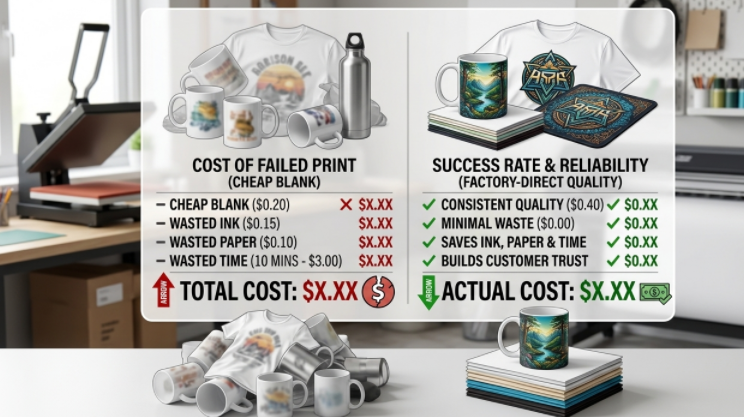
Dive Deeper: The Real Math of Your Business
Let's do the math. As a business owner, I live by these numbers. A designer like Emma needs to understand this to quote her clients accurately and remain profitable.
1. The True Cost of a Failed Print
Imagine you save $0.20 on a cheap mug. But because of poor coating, your failure rate is 20% (1 in 5).
- Cost of a failed print = $1.00 (cheap mug) + $0.50 (ink & paper) + $1.00 (your time/labor) = $2.50 loss.
- Over 5 mugs, you spent $5.00 on blanks, but one failed. Your real cost per successful mug is not $1.00, it's ($5.00 blanks + $2.50 loss) / 4 successful mugs = $1.87 per mug.
The premium $1.20 mug with a near-0% failure rate is actually much cheaper.
2. The Value of Brand Consistency
What is the cost of a customer who never orders from you again? When you use high-quality, factory-direct blanks, you know that the mug you sell today will be the exact same quality as the one you sell in six months. This reliability is what builds a professional brand. Customers pay for consistency. They are not just buying a mug; they are buying the confidence that what they see in your shop is what they will get. That trust is the most valuable asset your business has.
Conclusion
Stop blaming your technique for prints that fail. The single most important decision for sublimation success is choosing high-quality blanks. This saves you money, reduces waste, and protects your brand's reputation.

Hi there! I'm Lucy, the guardian angel of two good children. During the day, I am a professional in the heat transfer printing industry, from factory workshops to running my own business. Here I share what I have learned - let's grow together!